Curling is often associated with brooms, sweeping, and shouted commands across the ice. Wheelchair curling, however, has its own rhythm and rising stars. Born out of the Paralympic movement in the early 2000s, the sport demands accuracy, teamwork, and strategy.
As part of CAF’s commitment to spotlighting adaptive sports, we spoke with Steve Emt—a member of Team USA Wheelchair Curling and a 2018 Paralympian—about what makes the sport unique and why it’s gaining popularity among athletes with physical disabilities.
Wheelchair curling began in Europe and made its Paralympic debut at the 2006 Torino Games. Wheelchair curling accommodates athletes with lower-limb impairments who use wheelchairs for daily mobility. Since then, it has grown steadily, with teams competing internationally in world championships and Paralympics.
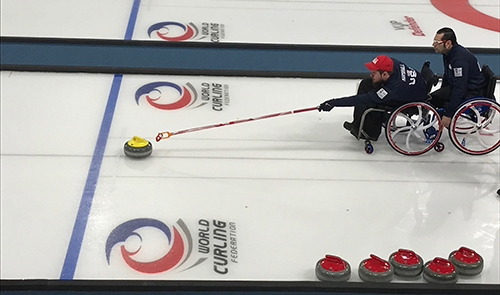
The rules of wheelchair curling follow many of the same principles as traditional curling:
Teams take turns sliding stones toward a target (the “house”) on the ice.
Each team throws eight stones per round (“end”), aiming to land closest to the center (“button”).
The team with the most stones closest to the button after all throws scores points.
But there are three key differences:
No Sweeping
In curling’s traditional version, sweeping influences a stone’s speed and trajectory. In wheelchair curling, there is no sweeping—meaning precision is everything. “Sweeping makes a lot of bad shots look good,” Steve explains. “Without it, you really need solid technique and a good feel for the ice.”
Delivery from the Hog Line
Instead of pushing off from a “hack” in the ice, wheelchair curlers deliver the stone from a stationary position near the hog line. This creates a different rhythm and requires strength, stability, and consistency.
The Delivery Stick
Athletes use a stick that attaches to the stone’s handle, allowing them to push and rotate the stone. This method accommodates athletes with a wide range of upper-body mobility and ensures fairness across abilities.
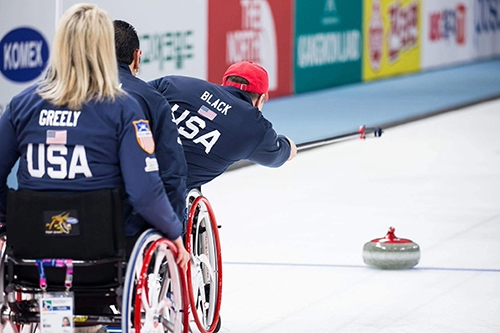
Wheelchair curling is one of the few co-ed Paralympic team sports. By rule, teams must include both men and women.
“Our team usually has three men and two women,” Steve notes. “It’s great to see men and women competing together at the highest level.”
This structure not only promotes inclusion but also strengthens teamwork and camaraderie.
Unlike other adaptive sports, wheelchair curling requires minimal specialized equipment—making it accessible:
Curling Stones: Identical to those used in traditional curling (about 20 kg granite stones).
Delivery Stick: A lightweight pole with a bracket that attaches to the stone handle for controlled release.
Wheelchairs: Everyday chairs can be used, though sport wheelchairs with anti-tip features offer added safety on the ice.
Ice Ramps (Training Only): Sometimes used for beginners to learn delivery mechanics.
The simplicity of equipment makes the sport approachable while keeping the challenge in the skill and strategy.
When Steve first took up curling, there were only about 15 competitive wheelchair curlers in the U.S. That number has since doubled—and continues to grow thanks to visibility at the Paralympic Games and local curling clubs offering adaptive sessions.
CAF supports this growth by funding grants for equipment, travel, and training, ensuring more athletes can try winter sports like curling.

Steve Emt’s story is as inspiring as his gameplay. After a car accident left him paralyzed, the former University of Connecticut basketball player turned to teaching—motivated to impact young lives. Sports remained a powerful outlet, and in time, he was recruited by the U.S. Paralympic wheelchair curling coach.
Now serving as vice-skip for Team USA, Steve competes on the world stage while mentoring new athletes entering the sport.
“Sports gave me my life back,” Steve says. “And now I get to share that experience with others.”
Wheelchair curling is contested at every Winter Paralympic Games since 2006, with China, Canada, and Norway often among the medal contenders. Team USA continues to rise in international rankings, powered by athletes like Steve and a growing domestic talent pool.
Athletes: Many local curling clubs now offer adaptive curling “learn-to-play” sessions. Check your regional curling association for opportunities.
Clubs: Want to expand your programming? CAF can help connect you with resources to start or grow adaptive curling offerings.
Supporters: Donate to CAF to help athletes access training and competition opportunities in adaptive winter sports.
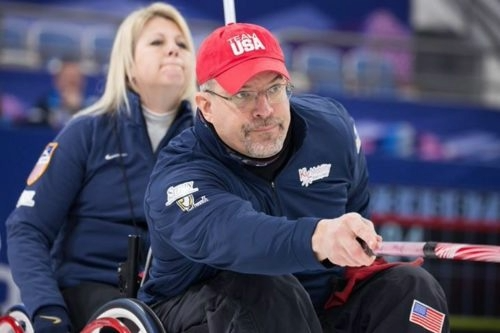
Curious about trying wheelchair curling? These beginner-friendly drills can help you build confidence on the ice. Ask your local curling club if they offer adaptive sessions, and start with these fundamentals:
Delivery Accuracy Drill – Place a target (like a cone) on the house and practice delivering stones toward it. Focus on consistent release and rotation using the delivery stick.
Weight Control Drill – Practice throwing stones at different speeds, aiming to stop them at varying distances. This helps you learn “weight,” or how hard to push the stone.
Line of Delivery Drill – Use markers on the ice to guide your delivery straight toward the target. Repeat until you can consistently stay on line.
Team Communication Exercise – Work with a partner to plan each shot, emphasizing strategy and verbal communication (since sweeping isn’t part of the game).
Game Simulation – Play mini-ends with a small group to practice real scenarios: placing guards, drawing to the button, or knocking out an opponent’s stone.
Even without sweeping, curling is about precision and teamwork—and these drills will help you build both.
Wheelchair curling is more than just a game on ice—it’s a showcase of strategy, precision, and inclusivity. With minimal equipment, a growing global community, and role models like Steve Emt, the sport is breaking new ground for adaptive athletes.
Whether you’re aiming for the Paralympics or just curious about trying a new winter sport, wheelchair curling proves that focus and teamwork can level any playing field.
Let’s keep growing the sport—one stone, one end, and one story at a time.