This article was written by CAF athlete Tristram Peters, who shares his knowledge and perspective on Power Soccer (Powerchair Football). Drawing from his experience in the sport, Tristram offers an introduction to how the game is played, the equipment athletes use, and how new players can get involved.
Power Soccer, also known internationally as Powerchair Football, is an adapted version of the beautiful game that we know and love. Designed for athletes who use power wheelchairs, the sport combines speed, strategy, and teamwork in fast-paced competition. With more than 30 participating countries, Power Soccer continues to grow around the world. Its highest level of competition is the FIPFA World Cup, but like the running game, it also has a strong grassroots movement, proving that soccer truly is a game for all.
Emerging in France and Canada in the late 1970s, Power Soccer was developed to create competitive sporting opportunities for people with physical disabilities who use power wheelchairs.
Belgium, Portugal, and Switzerland quickly adopted versions of the sport, with its growth culminating in the development of the international governing body, FIPFA, in the 2000s, which unified the laws of the game.
Since then, there have been four World Cups, played in Japan, France, USA, and Australia. The fifth will be played in Argentina in October, 2026, with France looking to defend their crown.
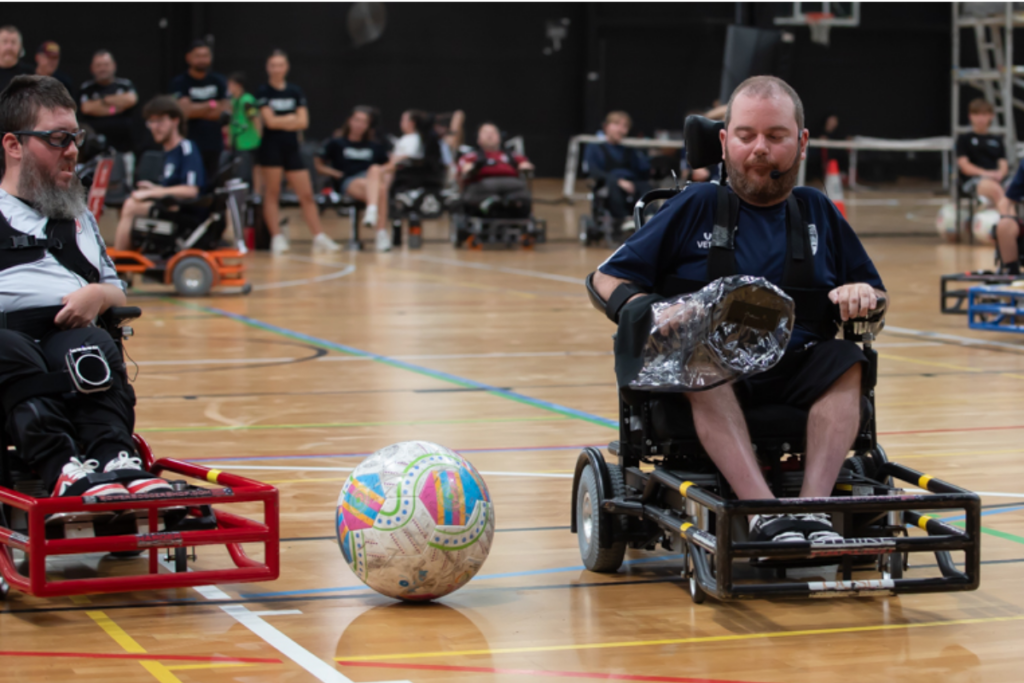
Traditionally played on an indoor court, Power Soccer athletes use large metal guards/bumpers attached to their powerchairs to hit a ball with pace and precision, in fast-paced, highly competitive matches.
Matches are played four versus four, with up to four substitutes per team. Like the running game, each team also has a goalkeeper. The only major difference in rules is the 2-on-1 rule, whereby only one player from each team can compete within a three-metre radius to ensure a free-flowing game. The only exemption to this rule is the goalkeeper, who is allowed a fellow defender in their goal area.
Power Soccer is played on a standard-sized indoor basketball court using an oversized soccer ball. Matches emphasize positioning, ball control, quick decision-making, and teamwork, making the sport both physically and mentally demanding.
Athletes attach metal guards/bumpers to their powerchairs, allowing them to push and dribble the ball on the court, or quickly turn to pass or shoot. Powerchairs are customised to each athlete’s individual need, with some using hand warmers to improve circulation while driving or straps for safety or postural support.
The majority of athletes use the Strikeforce, a powerchair specifically designed for Power Soccer. Its increased manoeuvrability, durability, and safety features allow players to accelerate, defend, pass, and shoot more effectively during competition.
Power Soccer utilises a classification system, to ensure the sport remains equitable. Based on their function, athletes are placed into one of three classifications:
P1: these athletes have limited vision and hand/arm function. For example, they cannot turn their head to see the ball and if their hand falls off the control, they might be unable to lift their hand back up.
P2: these athletes have increased vision and hand/arm function. For example, they can turn their head to see the ball if it were behind their chair and would be able to more easily get their hand back onto their control.
P3: these athletes have almost typical function, with little limitation to how they see the ball or drive their chairs.
This is a simplified explanation of a detailed classification system designed to ensure fair and equitable competition.
In FIPFA sanctioned events, each team must have two P1s on the court at all times, while P3s cannot participate. This is to ensure the integrity of the sport, so that P1s can participate equitably.
Power Soccer creates opportunities for athletes with physical disabilities to compete, develop new skills, and become part of a growing international community. Beyond competition, the sport builds teamwork, confidence, independence, and lifelong friendships.
Whether someone wants to play recreationally or compete internationally, Power Soccer demonstrates that athletes who use power wheelchairs can experience the same excitement, strategy, and passion that make soccer one of the world’s most popular sports.
Whether you’re interested in playing competitively or simply learning more about the sport, there are opportunities to get involved at many levels. Member nations are always looking for athletes, referees, classifiers, coaches, and volunteers to help grow the game.
If you’re interested in participating, contact your country’s governing body to learn about local clubs, development programs, and upcoming competitions. A list of member organizations can be found at fipfa.org.

Tristram is a writer, lecturer, and marketer with more than a decade of experience working in the disability and nonprofit sectors. Living with Spinal Muscular Atrophy Type 2, he is passionate about expanding equitable opportunities in sport for people with physical disabilities. Tristram serves on the boards of the Australian Powerchair Football Association and the Queensland Powerchair Football Association and has represented Australia as a member of the Australian Poweroos at two FIPFA Powerchair Football World Cups.