Pickleball’s easy-to-learn rules, fast action, and social vibe make it one of the most inclusive racquet sports. Adaptive pickleball takes it further—offering equipment modifications, adaptive gear, and adjusted rules so players of all abilities can participate, compete, and build community.
Minimal equipment is needed to play, but the following adaptive gear helps improve comfort, safety, and performance.
Sport Wheelchairs
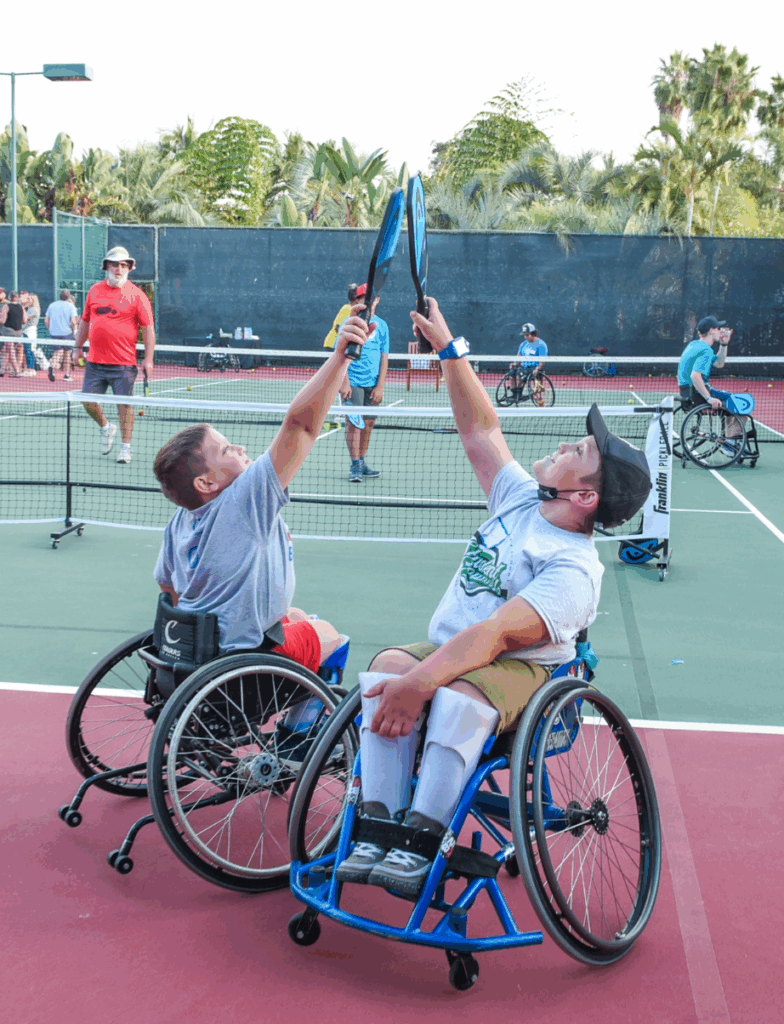
Tennis wheelchairs are used due to their maneuverability: lightweight frame, low backrest so swing isn’t blocked, cambered wheels for stability and quick turns, anti-tip casters in back, and safety straps for secure seating.
Multi-sport wheelchairs offer adjustable footrests, seat height, and other customizations for players who play more than one sport.
Paddle Grips & Wrist Guards
Modified grips help those with limited hand strength or grip control. Wrist guards help stabilize the wrist during swings and protect from injuries.
Pickleball Retriever
Designed to help pick up balls from the ground without bending over (useful for people with mobility limitations). It attaches to the paddle grip and uses suction to retrieve balls.
Leg & Foot Straps
Straps secure the lower limbs in the chair (thighs, calves, feet) to improve stability and safety during rapid movements.
From external sources, here are common modifications in adaptive or wheelchair pickleball:
Two-Bounce Rule: Players in wheelchairs may be allowed two bounces of the ball on their side before returning.
Wheelchair as Part of the Body: The chair is considered an extension of the player. If the ball hits the chair (unless intentionally blocked) it remains in play.
Serving Rules: Rear wheels must stay behind the baseline when serving. Some rules allow one push of the chair before hitting the serve.
Court Size & Layout: To allow more space for wheelchair movement, adaptive courts or recommended playing surface areas are larger than standard courts (wider sideline clearance, more space behind baselines).
Physical benefits: improves hand/arm strength, balance, coordination, cardiovascular health.
Social & emotional benefits: builds community, lowers isolation, boosts confidence.
Low barrier to entry: equipment modifications are often simple (grip, strap, retriever) and rules are flexible. Many players can start quickly.
Inclusivity across impairments: not just for wheelchair users. Visual, mobility, grip, hearing, or cognitive impairments can all be accommodated with adjusted rules or equipment.
Here are drills or practices an adaptive pickleball player (or coach) can use to build skill and confidence:
Grip & Paddle Control Drill — Practice swings with modified paddle grips, focusing on control over power.
Wheelchair Maneuvering — Work on moving forward/backward and turning in the chair while holding the paddle; improves court coverage.
Service Practice — Practice serving from baseline with wheelchair rules (rear wheels behind baseline); aim for consistent delivery.
Bounce-Timing Drill — Play or practice rallies allowing two bounces to give more time to reach the ball, especially helpful for those with slower mobility.
Court Positioning & Strategy — Practice doubles or singles positioning; communicate with partners about coverage, movement, and shot placement.
Athletes: Seek local clubs or community centers that offer adaptive pickleball or wheelchair tennis programs—they often overlap.
Facilities / Courts: Ensure courts are accessible (surface, ramps, space). Consider modified nets, adjusted baseline or spacing if needed.
Supporters & Coaches: Donate or grant adaptive equipment (wheelchairs, grips, straps). Coaches should learn adaptive rules and be flexible with modifications.
USA Pickleball’s Wheelchair Pickleball division provides guidance and rules modifications.
Adaptive Pickleball nonprofits (like Adaptive Pickleball in Upstate South Carolina) host “Play Days” and inclusive sessions.
Adaptive pickleball shows that with simple adjustments, most people can enjoy the speed, strategy, and fun of the sport. Whether you use a wheelchair or modify a paddle grip, what matters is being on the court and playing exchange by exchange, rally by rally.
This resource is intended to be used for informational purposes only. The information contained does not reflect an endorsement of these products or companies by CAF.