“In the disability world, I still get stared at. I mean, I have no legs and roll around on a skateboard. It throws people off. But that’s never stopped me from showing up.” – Paco Torres
Paco Torres once described himself as “the most disabled person he knew.” A double amputee with six fingers total and no formal athletic background, Paco never imagined himself as a competitive athlete — let alone a starter on a high-performance wheelchair rugby team.
But what began with a chance encounter in a Tucson bar eventually led him to a community of elite adaptive athletes, a new identity as a high-pointer in quad rugby, and a renewed sense of purpose as a father, husband, and competitor.
This is his journey.
Back in 2009, I was alone in a bar near the University of Arizona, talking to my then-girlfriend on the phone. Out of the corner of my eye, I noticed three guys in wheelchairs shooting pool.
Something told me I should talk to them. So I downed my beer, hopped off the barstool, and glided over on my skateboard.
“Hey, do you guys play any sports for the U of A?”
They looked surprised — probably not just by the question, but by the sight of a guy with no legs rolling up on a skateboard. Even in the disability world, I stand out.
They smiled and said, “Yeah, give us your number. We’ll call you.”
I figured they wouldn’t. I mean, I was an out-of-shape, 38-year-old single dad with no wheelchair and no real sports experience. It felt a little like trying to walk onto a college team as Rudy — only with fewer limbs.
But a few days later, my phone rang.
“We have open tryouts. Just come by the U of A on Wednesday or Saturday mornings, and we’ll get you a chair.”
My heart sank. I wanted to say yes, but I didn’t know how to make it work.
At the time, I had full custody of my 4- and 6-year-old daughters every weekend. With a full-time job and no backup childcare, squeezing in practices felt impossible. So I told them I couldn’t make it.
But the desire didn’t go away.
Not long after, a local men’s wheelchair basketball team — the Tucson Lobos — invited me to play. Practices were on Tuesday and Thursday nights, close to my office. That, I could make work.
For five years, I played with the Lobos. I improved in every area… except shooting.
Our coach used to laugh at me and say, “You really don’t have the hands for basketball.”
With four fingers on one hand and two on the other — he wasn’t wrong.
He eventually suggested I try wheelchair rugby instead.
I didn’t listen. I kept playing basketball anyway.
Fast forward to 2015. My girlfriend Emily and I were now married. My kids were older. Things were more stable.
And then this Danish guy — who looked suspiciously like the actor Chris Elliott — showed up at our basketball practice. He claimed he was there to play, but based on his lack of arm strength, we weren’t sure he could shoot.
After practice, he approached me.
“You need to try wheelchair rugby. We practice Saturday mornings.”
I declined.
“That’s time I spend with my kids.”
The next week, he came back.
The week after that, again.
By the third time, I finally said, “OK.”
I showed up at 9 a.m. for rugby practice and learned a new concept: Quad Time — basically, the game doesn’t start until everyone is ready, which can take over an hour with all the gear and limited function many of the athletes have.
By 10 a.m., we were finally on the court.
The chair they gave me was… massive. Giant red wheels. A deep bucket seat. It looked like an armored tank — and felt like one too.
“So, in this game, you’re the high pointer,” the coach said.
“You carry the ball. If you’re good, you score on every play.”
Wait, what?
In basketball, I was teased for my hands. Now they wanted me to handle the ball every time down the court? I didn’t get it.
But they explained: in quad rugby, I actually had the best functional hands on the team. They didn’t want me to pass — just carry, follow my pickers, and score.
So we played… and I was terrible.
I passed constantly, caused turnovers, and moved like a confused basketball player in a demolition derby.
“Stop throwing the ball!”
“Slow down!”
“Follow your pickers!”
But they didn’t give up on me.
And more importantly, I didn’t give up on myself.
My wife supported me from the start. She watched the kids while I went to Saturday practices. Eventually, we even started driving two hours to Phoenix on Wednesday nights so I could train at Ability 360, one of the top adaptive sports facilities in the country.
That’s where I met Nick Springer, a USA Paralympian and fellow amputee who lost his hands and legs to meningitis at 14. Nick didn’t know me from a pile of bricks, but he coached me like I belonged.
“Seeing Nick push faster than anyone — with no hands — showed me what was possible.
I figured if he could do it, I could get better too.”
I also trained alongside Team USA Captain Joe Delagrave and former Paralympian Scott Hogsett, featured in the documentary Murderball. They taught me strategy, movement, how to navigate the court — and how to stop dribbling like a basketball player.
Bit by bit, I started to feel like I was part of the team.
(Side note: I’ve surveyed a lot of people with spinal cord injuries and amputations. No one chooses amputation — they’d rather have a painful leg than no leg. That’s why I respected Nick so much. Like me, he didn’t have a choice — and we had that in common, along with a twisted sense of humor.)
As the summer ended, I had a choice: join the U of A team, the Phoenix Heat, or the Tucson Renegades — a squad that included four Team USA players.
I chose the Renegades.
Not only were they in Tucson, but they welcomed me, believed in me, and offered me something I hadn’t felt in a long time: belonging.
They even invited me to train in a closed session with Team USA — not to try out, but as a developmental player. To learn. To grow. To belong.
And to think — this all started with a beer, a skateboard, and a question in a bar.
When I started this journey, I thought of myself as “the most disabled person I knew.”
Now, I’m surrounded by people who push the limits of what’s possible every day. I’ve found a team, a community, and a version of myself I didn’t know existed.
I still get stared at. I still make mistakes. And I still have six fingers total.
But I also have something else: momentum.
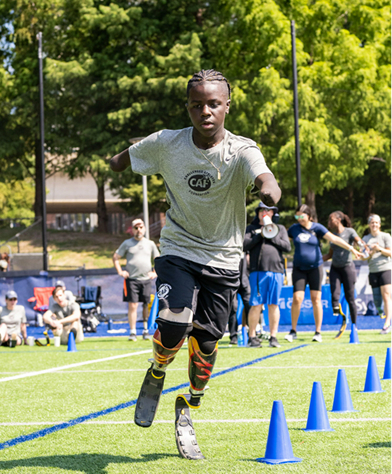
Organizations like the Challenged Athletes Foundation (CAF) were part of the fabric that helped make this possible — connecting athletes like me with equipment, opportunities, and most importantly, community. Adaptive sport gave me a second chance at being an athlete. CAF made sure I wasn’t doing it alone.

Sign up for stories of resilience, event invites, and ways to make a difference delivered with heart, straight to your inbox.
Thank you for subscribing! Check your inbox regularly for updates
from the CAF team.
Apply for grants for adaptive sports equipment, prosthetics, coaching, and more.
Find adaptive experiences and events for your sport near you.
Find adaptive experiences and events for your sport near you.
Learn about outreach, awareness, and education programs for schools.
Join programs in our key regions.
Adaptive Sports Organizations listed by state and country.
Browse our resources by sport to find the right equipment, trainings, and organizations for you.
Make a 100% tax deductible donation with one click.
Donate every month. Just $10 makes a
difference.
Find another way to give that works for you.
Get in front of an engaged and passionate audience and support our mission while advancing your goals.
Create an impact by sponsoring life-changing events.
Support your corporate giving initiatives with 100% tax deductible donations.
Create an event you’re passionate about in a few easy steps.
Contribute to or take part in an existing event.
Learn how to get your school involved in a great cause and access tools for success.
Explore digital or in-person volunteer opportunities at a CAF event near you.
Join inclusive adaptive sports events and experiences open to everyone.
Discover upcoming events in your area to fundraise, participate, or volunteer.
Find something that moves you. Athlete stories, event coverage, and more.
Explore our resource library to access information on your adaptive sport.
Explore our video library to get digital coaching, equipment guides, and more.
Access the tools you need to best support your fundraising efforts.